KRACHEH
Wat Roka Kandal and the 100 Pillar House in Kracheh (Kratie)
We headed out for the afternoon wanting to see a few more of Kracheh’s sites. After lunch at Kampi Rapids, we continued north to the 100 Column Pagoda before making our way back towards Kracheh, stopping at Wat Roka Kandal and the 100 Pillar House on the way.
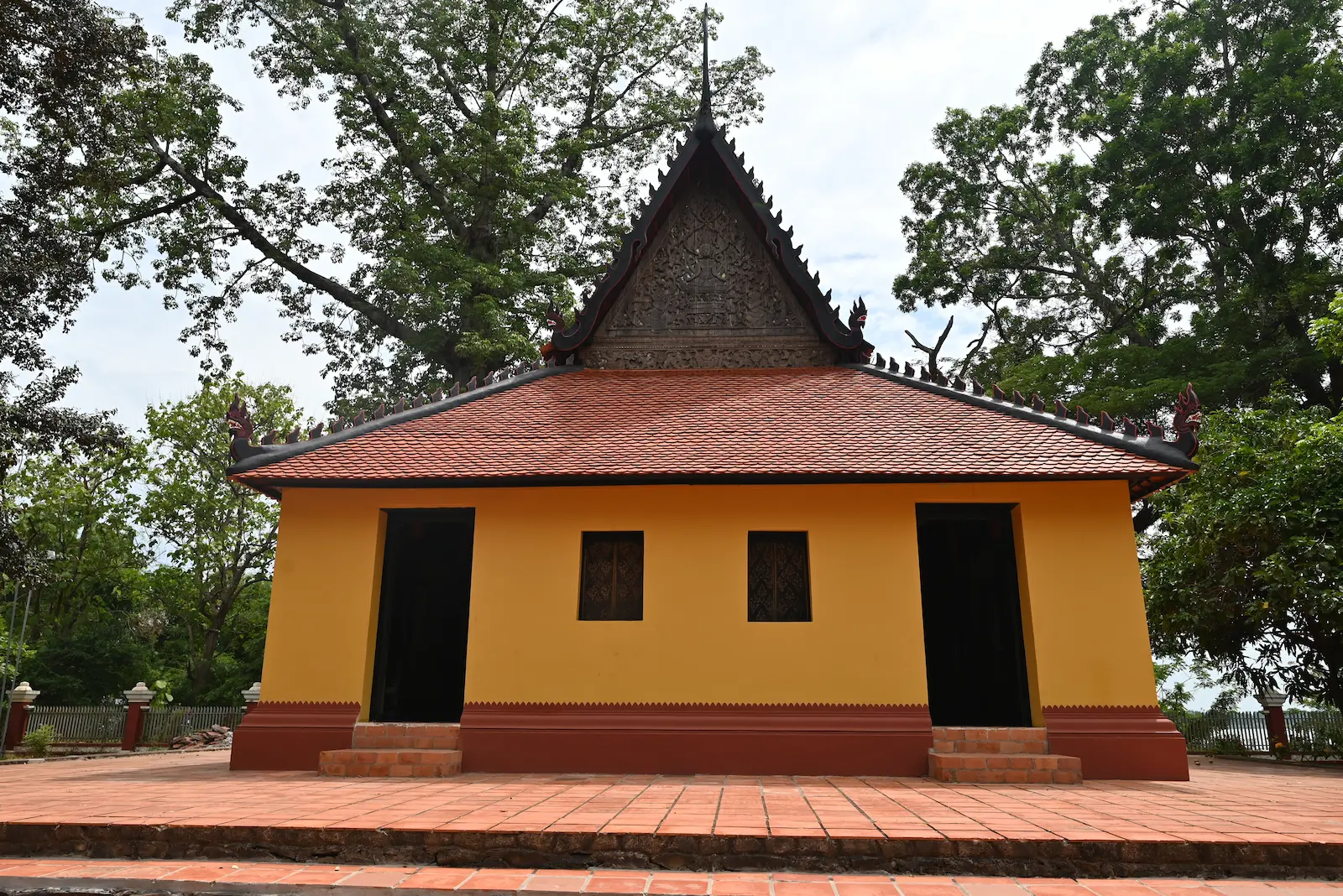
Wat Roka Kandal is a historic wooden pagoda dating back to the late 18th or early 19th century. Originally named Wat Botomny Vannaram, it was restored in 2002 and again more recently in 2025. According to the information board at the site, the name Roka Kandal comes from a roka tree that once grew here.
Visiting Wat Roka Kandal (វត្តរកាកណ្ដាល)
Although it’s a small pagoda, it is rare to see an old wooden vihara so well preserved. During the civil war, many of the remaining wooden pagodas were destroyed, and those that remained have disappeared through deterioration or from being replaced by more solid structures.
From the outside you can see the wooden carvings in the pediments, with the contrasting yellow paint and red roof tiles making it stand out. It is kept in excellent condition. We tried to work out what the carving was, but hadn’t seen the four-armed figure before. Nehru thought it might show a scene from the Reamker, the Cambodian version of the Ramayana, surrounded by what look like flames.
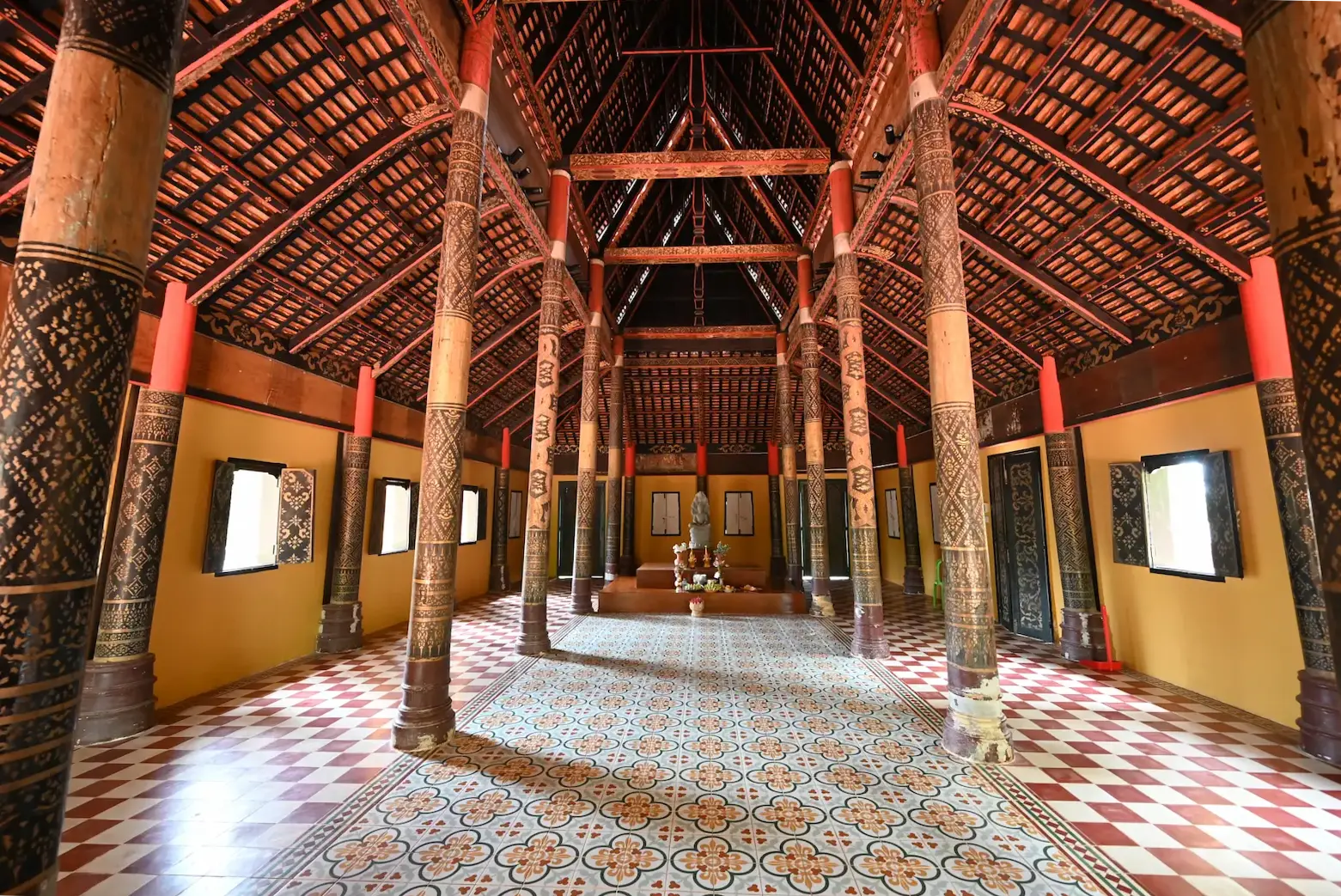
Inside it’s all about looking up. You can see the intricate stencil work on the wooden pillars, while above them is a lattice of crossbeams and a carved central roof truss opening up towards the peak of the roof. The contrast of the red paint, brown wood and the beautiful tiles makes it quite striking next to the yellow walls. The pagoda is open with a small altar at the front. It’s quite humble but beautiful.
Opposite you will find the newer version of the pagoda. We didn’t bother visiting, instead heading to the 100 Pillar House, which shares the site. At first we thought the 100 Pillar House was in Chhlong, until we turned up at Wat Roka Kandal and found it there.
The 100 Pillar House (ផ្ទះសសរ១០០)
The traditional Khmer wooden building is thought to be around 200 years old and was originally located in Chhlong. In 2020 it was dismantled pillar by pillar and moved to Wat Roka Kandal. It has since been granted national heritage status and turned into a small museum.
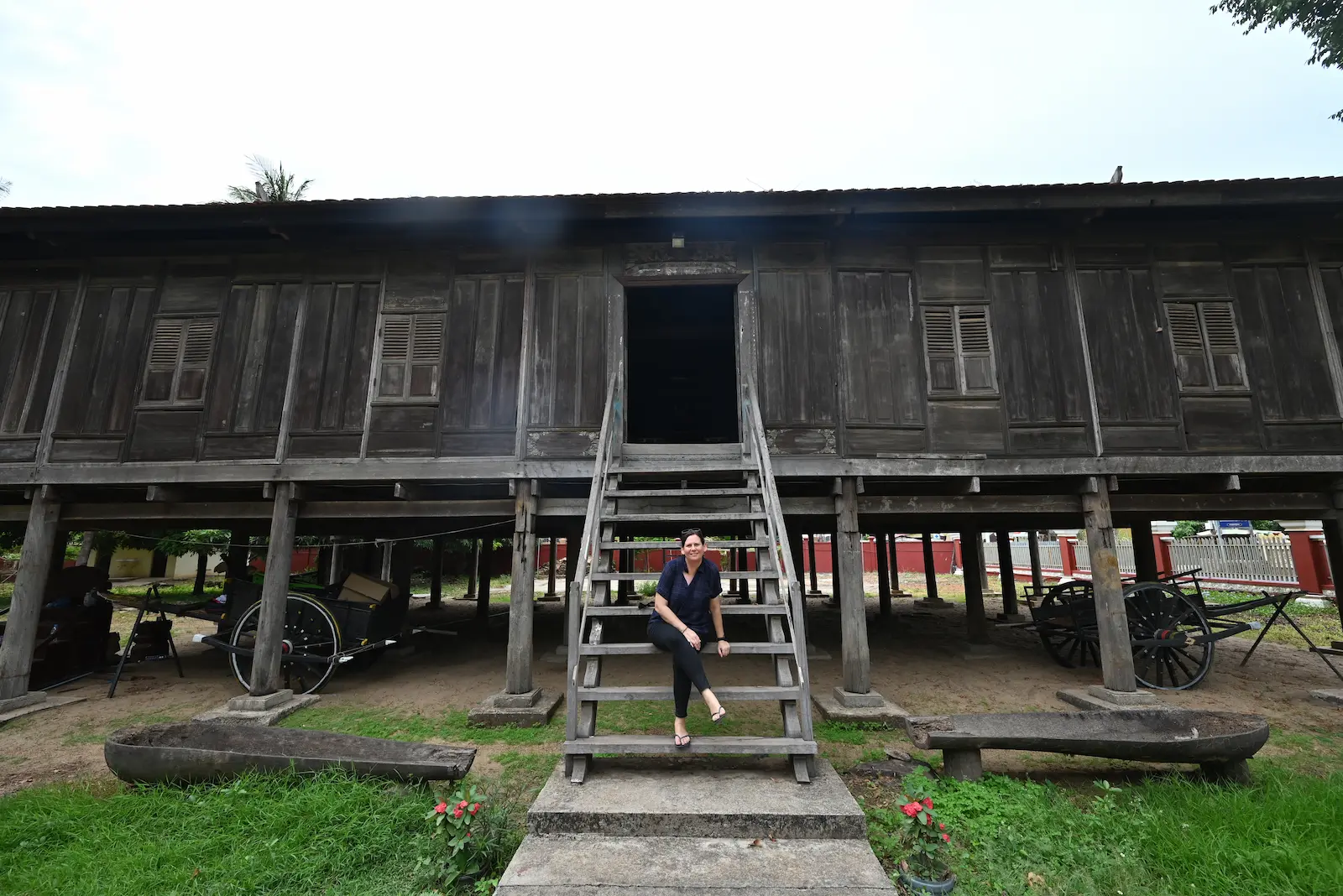
The house had belonged to the same family for several generations. When they could no longer afford the repairs and planned to split the land between their children, they sold the house to the Ministry of Culture and Fine Arts for $8,000.
One of the first things you might notice when you enter is that there are not 100 pillars. Many were lost or deteriorated over time, and only around 40 remain. Built from rosewood, a timber that is now increasingly rare in Cambodia and heavily affected by illegal logging, the house also lost some of its pillars during the Khmer Rouge period.
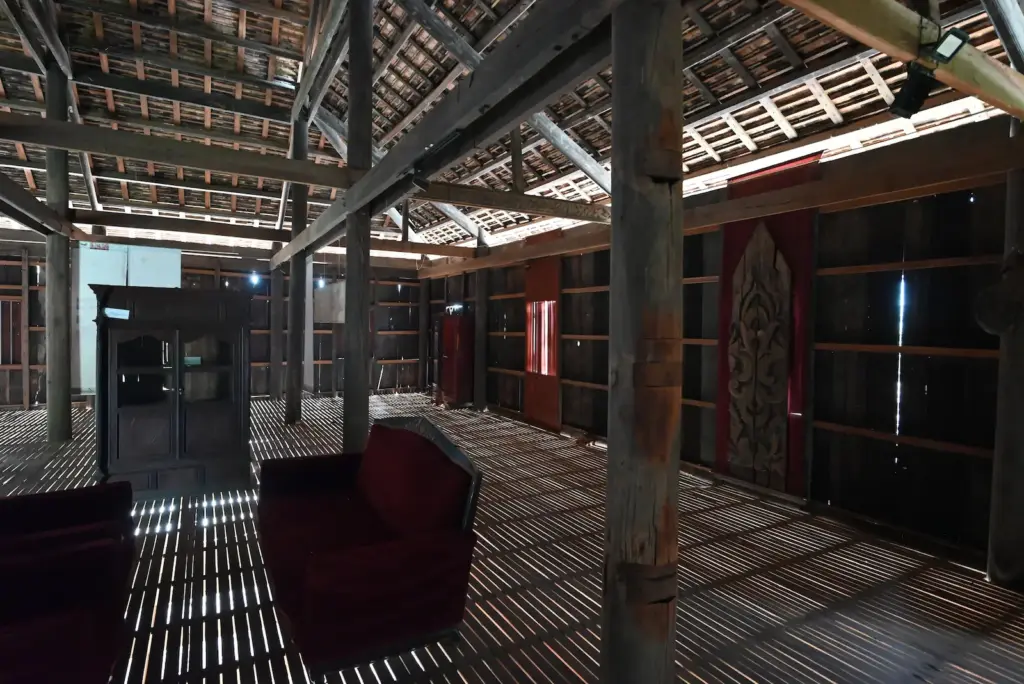
When we first stepped inside we noticed the floorboards straight away. Beautiful thin lines, with shards of light peeking through. The roof had a similar lattice-like feel to the pagoda, although with no carvings or paint.
Inside were a number of antiques and pieces of traditional furniture, as well as statues and other artefacts. There were signs, but all of them were in Khmer, so it is best to use Google Lens if you want to read them.
I admired the intricate woodwork in the beams and on the furniture, while Nehru enjoyed connecting some of the artefacts to his childhood. We both noticed how cool it was inside and enjoyed the breeze coming through the doors and windows.

It’s also worth a peek under the house to see the bottom of the pillars and a couple of old ox carts. Outside, my favourite details were the carved floral panels that still had traces of their original blue and yellow paint.
We spent nearly an hour wandering around here, although for most people 15 minutes would probably suffice. Both buildings were free to visit.
The 100 Column Pagoda (វត្តសសរ១០០)
Now you don’t want to get confused between the 100 Column Pagoda and the 100 Pillar House. They like to build things in hundreds in Kracheh.
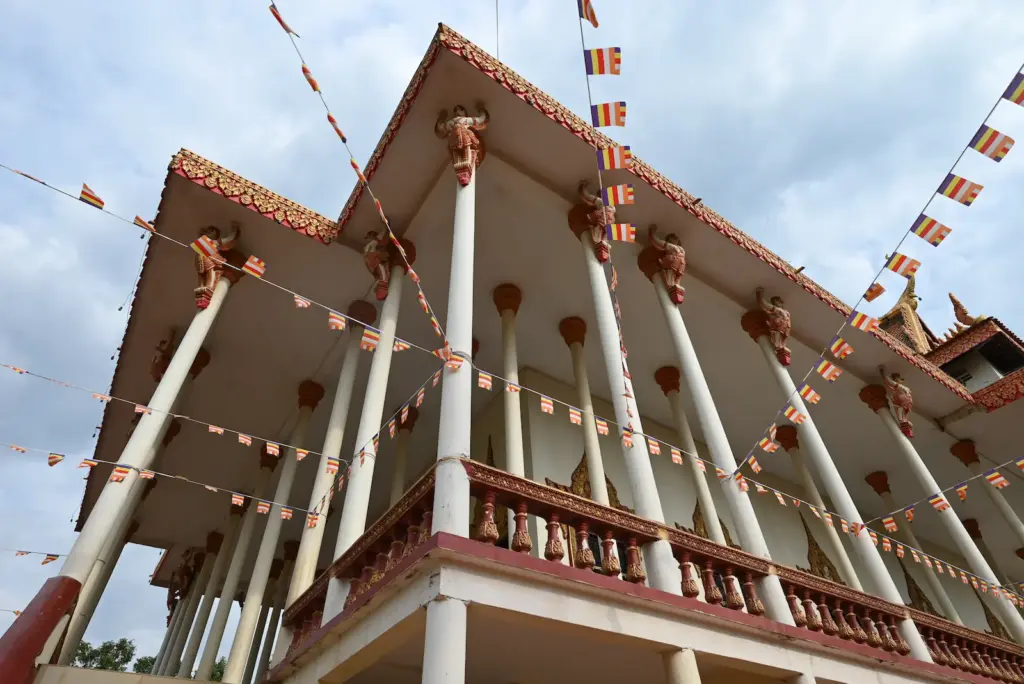
Actually, the 100 Column Pagoda apparently has 116 columns following its most recent renovation, but we didn’t take the time to count. It is also quite unusual because it faces north, while most traditional Cambodian pagodas face east.
There is also a rather strange local legend behind the pagoda. The story tells of Nen Thun, a man who accidentally transformed himself into a crocodile after experimenting with his master’s magic. He would then carry his master across the Mekong to treat a sick princess. During a fight with another crocodile, Nen Thun swallowed his master to protect him, but by the time the fight was over his master had died. Blaming the princess for his death, Nen Thun later swallowed her too. The king sent his men after the crocodile, but they were too late to save his daughter. According to the legend, the 100 Column Pagoda was then built in her memory.
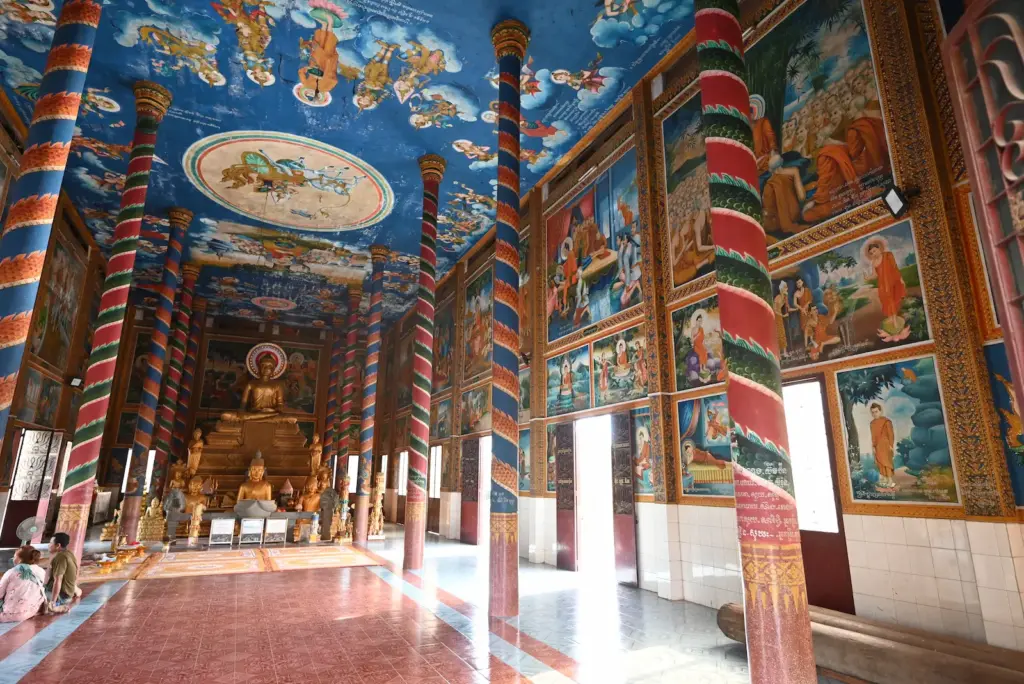
We enjoyed wandering around some lovely gardens and looking at the pagoda but most of our time was spent trying to get as many of the columns into a photo as possible. You can go inside, where there are some vibrant murals.
It also used to be home to the Mekong Turtle Conservation Center, but the centre is now permanently closed.
It is a popular pagoda and while we were there, two large buses of monks and worshippers arrived. We enjoyed the ride out here, but we may not have bothered if we had less time. It is quite a way from town and we didn’t find anything else we could pair it with. But if you enjoy looking at beautiful pagodas, it really is lovely.
We visited Kracheh in May 2026
Related Posts